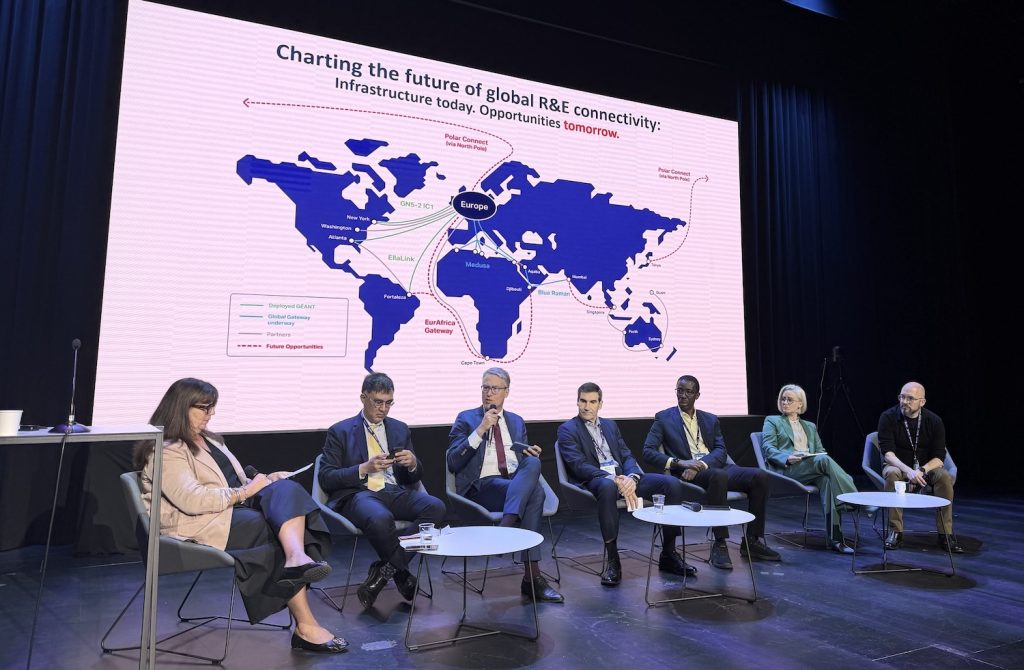
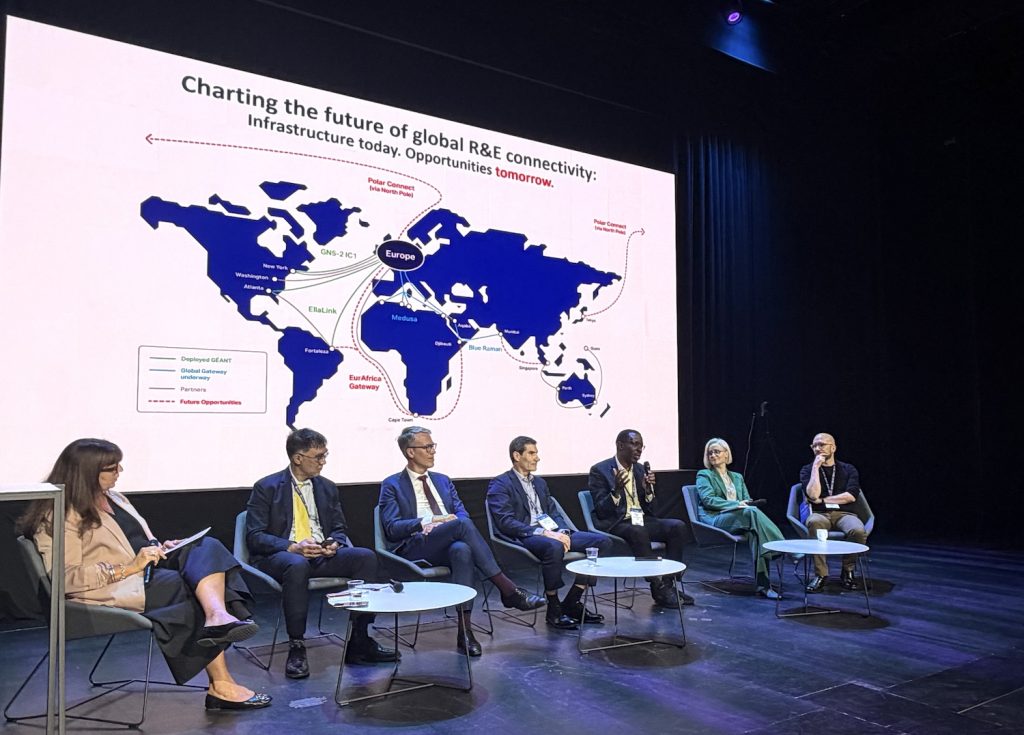
One of the opening sessions at TNC2026 explored the emerging strategic era of intercontinental submarine connectivity infrastructure, including ongoing projects such as Medusa and Blue Raman, and opportunities such as Polar Connect and EurAfrica, in which Regional Research and Education Networks, including GÉANT, NorduNET, ASREN, WACREN and UbuntuNet Alliance have a direct stake. The assembled panel dove into discussions around several key questions, including who shapes the future architecture of international connectivity? Who benefits? Can public-interest infrastructure remain open, trusted and sustainable in an increasingly competitive and fragmented global environment?
The panellists included Madara Ogot (CEO, UbuntuNet Alliance), Hoa-Binh Adjemian (Head of Unit, Private Sector Engagement, DG ENEST, European Commission), Jean-François Le Bihan (Project Manager, Secure Connectivity & Digital Infrastructure, DG INTPA, EC), Manuel Tarazona Cano (Senior Engineer, Digital Infrastructure Division, European Investment Bank), Bram Peeters (Chief Network Services Officer, GÉANT), Ieva Muraškienė (Strategy and Policy Officer, NORDUnet & Chair of GÉANT Network Infrastructure Advisory Committee).
In his contribution, Prof Ogot noted that the UbuntuNet Network currently meets European, and by extension global partners, in London and Amsterdam at a high cost to its member NRENs and downstream institutions. With the Medusa cable connecting Europe to North Africa, the Blue Raman cable from Europe to India, connecting with the the Alliance Network in Djibouti, and the proposed EurAfrica Gateway cable connecting Europe to Western coastal countries of Africa down to Cape Town, South Africa, Europe and the rest of the world shall now be meeting African Regional Research and Education Networks on the in Africa, resulting in major cost savings that shall be passed on to the African RRENs’ member NRENs.
Prof Ogot further noted that, “most of the universities and research institutions on the continent are government institutions with fixed budgets for ICT, which includes Internet and everything else. If you can reduce the cost of Internet access for these institutions, their capacity increases significantly. As of now, very few universities have enough capacity for their students … the cables are a huge game changer for all institutions on the continent”
On equity, Prof Ogot observed that one can now afford to move large datasets back and forth between Africa and the rest of the world as the costs in Africa continue to drop, though we are not yet there. The Medusa, Blue Raman and the proposed EurAfrica Gateway cables shall contribute significantly to making the cost of data transfer from Africa comparable to other parts of the world, making it easier for Africans to fully participate in cross-continent research and education activities that rely on robust connectivity.